Saturday, April 17, 2010

Nanna dearest,,...


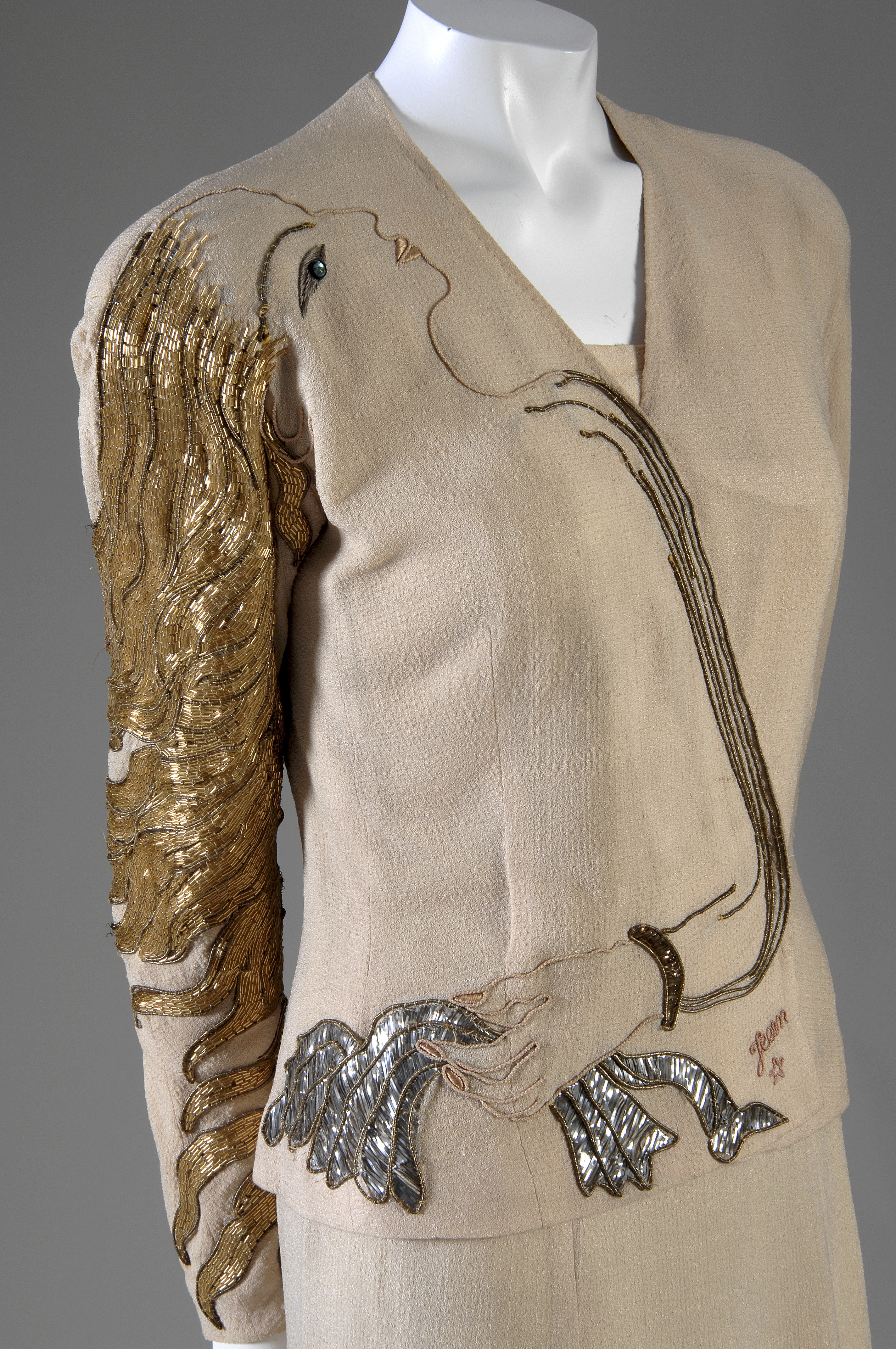
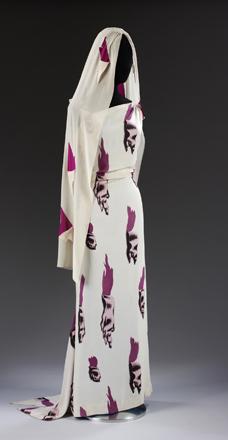
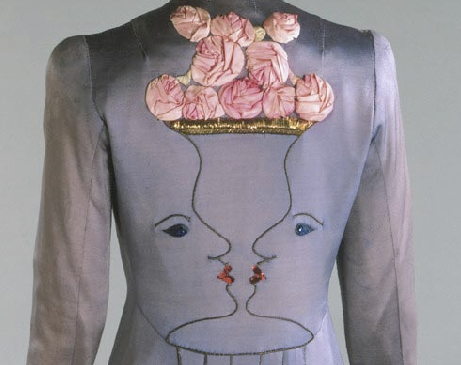
Elsa Schiaparelli


The act of decoration is merely the process of making something more ‘attractive’-however what to categorise as ‘attractive’ can be a debated topic. For this particular task I strayed in the field of predictability when it came to creating decorative elements that were ‘attractive’-such as something as cliché as rosettes.
Integrate- to join two or more objects or make something part of a larger whole, or be joined or made part of a larger whole. I am more interested in decorative techniques as a textile form as opposed to an application. But for the sake of experimentation I intended to incorporate both decorative and integrated methods of decoration for the nanna briefs.
Whilst investigating the ‘decorate or integrate nanna’ task I came to discover just how widely decoration is used. The simplest of garments can be made extravagant purely through decorative elements, not to say I am largely in favour of this but I am able to appreciate some decorative works and admire their beauty.
I recently have been quite interested in the work of surrealists and their theoretical views, in pursuing this research I stumbled upon a fashion designer Elsa Schiaparelli who produced some of her best known works in collaboration with Salvador Dali. Her designs created in the art deco period had fascinating use of decoration which really inspired me for the nanna exercise. There was some kind of a minimalist sense conveyed ironically, as who would have categorised decoration with minimalism. . Her decorative elements also appeared as if they were strategically placed with precise calculation.
The term minimalism is also used to describe a trend in where the subject is reduced to its necessary elements; in this case ornamentations being about quality rather than quantity. Thus I decided to take this approach for my nanna briefs rather than ‘over decorating’ –I felt there would be a more refined beauty achieved.


Surprisingly I enjoyed the process of constructing the decorative nanna briefs. Whilst in class, I experimented with different ways of creating a textile surface through smocking and tucking. The process I found most effective was making textile out of a series of overlapping tucks travelling in different directions. It created an interesting texture and made one wonder and ask ‘how was this achieved?’. Thus I thought to continue this approach on my toile. I initially wanted the entire back piece to be made out of the tucks. I thought the best way to do this would be to get the fabric and then place the pattern and cut the piece out- in that chronological order. However I wasn’t aware of how much fabric it would actually take to fill the pattern piece. The fabric dramatically shrinked in size after the tucks were completed. Due to this being a tedious process and extremely time consuming I opted to incorporate the tucks into the side panels of the nanna, and thus make it a minor detail of the nanna.
Throughout this generic garment investigation I have learned that achieving your desired/intended result proves to be an immense challenge (for myself at least). Largely due to either the complexities of design or in most cases the behavior of the stretch fabric which is rather hard to predict and would require several toile’s before coming across anything close to perfection. Conversely I have learned to accept this and embrace it, as Salvador Dali says “Have no fear of perfection - you'll never reach it……………………Mistakes are almost always of a sacred nature. Never try to correct them. On the contrary: rationalize them, understand them thoroughly. After that, it will be possible for you to sublimate them. “


Wednesday, April 14, 2010

Generic Garment Invest.- Image Ideas/intention

I am intrigued with the beauty of the simplest non remarkable object captured in a dynamic moment.
Capturing the essence of truth. Something that may appear ordinary in its origin but has an illuminating essence of life that is not artificial. A shot in movement is further embedded in your mind as you wonder what the shot before and after that moment would have appeared like and I suppose you almost create this in your mind.
The video from American beauty always reminds me of this.-“and that’s the day I realised that there was this entire life behind things”.

(Ignore the poor quality of the video).


I wish to convey what my message about the generic garment investigations findings are without it being literal, telling the story in an abstract sense of thought.
To capture a feeling, a truth. A moment in time.
Let it take your thought without controlling it.
Don’t restrain from a feeling of movement or desire. Don’t deny the truth being captured in your mind.

The generic garment- You can twist it and pull it, but does it still remain to be the original object?
Will it ever cease to remain the object of desire?

Monday, April 5, 2010

Week 4- Possible 'Project:STRETCH' response


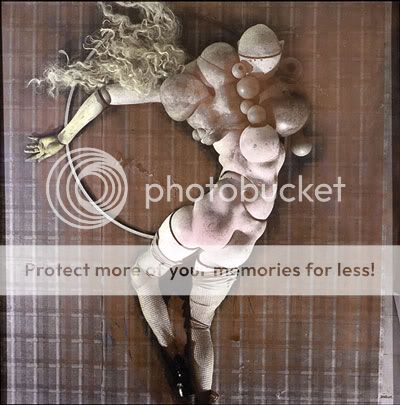
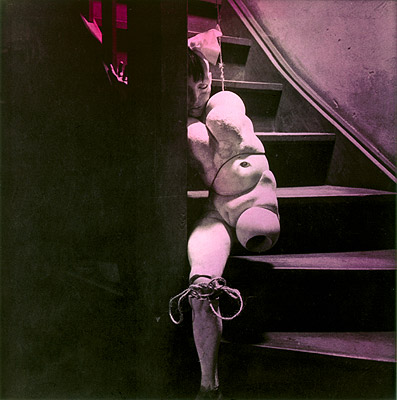
(The artwork of Hans Bellmer- all images above)

The body was a site for Surrealist experiment and a conduit for the transmission of ideas. It became the subject of intense scrutiny: dismembered, fragmented, desecrated, eroticized and eulogized in the pursuit of a range of psychological, sociological and sexual concerns. These processes were iterated in mind and physical act. For instance, Hans Bellmer pulled mannequins apart to create violent new forms. Fashion brought it into a direct relationship with commodities, and through the imagery of fashion and fashion photography it was manipulated, fetishized and irrecoverably changed.
For the surrealists, the mannequin embodied the dialectics of modern life. It confused the boundaries between animate and inanimate, human and machine, male and female, the sexualized and the sexless, and ultimately life and death. It was simultaneously a commodity, a simulacra, an erotic object, and the embodiment of the uncanny.
In the Freudian uncanny the mannequin also represented the return of a suppressed elementary or primal human emerging from the unconscious. It provoked a sense of ’the crossing of the human and the non human’
(‘The Surreal Body: Fetish and Fashion’, Ghislaine Wood)


These passages express an idea and point of view which I find very intriguing and wish to further explore as a possible concept for the final project. To develop the theoretical view of these surreal artists into the way I approach the possibilities of stretch wear for this project.


Saturday, April 3, 2010

WEEK 3- leggings part 2- 'Morphing against humanity'


(First image from http://news.bbc.co.uk/media/images/41906000/jpg/_41906168_glove_pa_220.jpg, rest of the images are my own)

I took the idea of deformation in the structure of morphing and the addition of ‘extra limbs’. I instantly was grabbed by the idea of morphing- ‘to cause something to change its outward appearance completely and instantaneously, or undergo this process’ . Morphing against humanity -In the same rationality with the generic garment investigation we are in a sense trying to ‘morph’ the generic garment into its anti human self. Deconstructing all the features of the garment that is well-known and accepted by society.
My idea for the leggings didn’t turn out quite as expected but it did create an interesting prospect. Rather than stuffing the legging with foam I decided to take a different approach and fill some of the ‘glove fingers’ with bags of pebbles-as influenced by the work of Ernesto Neto. The affect this created was in essence the appearance of an almost melting glove- or possibly more so some form of multi legged creature? I do feel it was successful in deforming the body- due to the pattern of the legging being a large glove in shape; it created a low crutch on the leggings which dramatically shortens the length of the legs whilst extending the upper body. The other obvious outcome being the malformed appearance of extra limbs.

Tuesday, March 23, 2010

Week 3- Leggings; 'Abstracting/Deforming the body's form'.


"Fashion is conceptual and functional; its compelling nature is that it can be either or both" -(a quote from ‘Breaking the Mode’ by Kaye Durland Spiker & Sharon Sadako Takeda)


I found that this quote is an accurate summary of stretch wear particularly this generic garment project. We are learning about the generic items of stretch wear that are worn and popularised solely for functional purposes and we have been given the task to conceptualise these generic items proving that a garment can be both functional and conceptual. Progressively in this studio I have observed that stretch fabrics have the ability to create endless possibilities in terms of drape, shape and fit. The pattern making process for the design exercises we have toiled so far have been based purely on one’s instinct and vision, there are no rules, but merely judgement. The final result cannot be determined until it has been tested. In order to achieve the perfect/desired fit, shape or drape, a number of alterations would need to be made after each toile.
This week I documented a number of body experiments for the leggings exercise before I came upon my final idea-which is still in the stage of development. Endeavouring to deform and distort the natural contour of the body I found the shape of gloves mesmerizing, exploring the interesting forms and movement that a glove or numerous gloves can make through drape or being blown up. Focusing on further research I happened to stumble across the Comme des Garcons collection that incorporated gloves- such a simple and basic item that has been revolutionised to structure as part of a garment as opposed to being a separately worn accessory. I am looking forward to seeing how this idea will translate as patterns and finally as a garment-will the outcome be a success of failure? I ask myself.


(Comme des Garcons image from http://www.textilemuseum.org/images/exhibitions/JapaneseContemp/Kawakubo_Dress%20Gloves%20Hatweb.jpg)

Friday, March 19, 2010

WEEK 2- Singlets; the idea of the 'body conscious' garment


I found the process of fitting or I suppose ‘sculpting the garment to the body’ using the fabric gave me a better understanding of construction and how obviously the body is a contour form with 3-dimension not a flat surface.
Form fitting garments are often seen in today’s culture. People feel they have to extenuate and show every curve of the body as apposed to hiding it in volume, as there is a general idea of it being more arousing.
"Eroticism, is another word for that brief moment when skin flashes out from behind the cloth. Where even nakedness signifies a kind of being dressed. For the human figure to appear in its naturally beautiful incarnation the material element must be made to disappear."-(from the Fashion Zeitgeist written by Barbara Vinken).
I felt that this quote was a very interesting view about I suppose the correct terminology would be ‘form fitting or ‘body conscious’ garments. It evoked quite a bit of thought in me when I was experimenting with the cut and paste exercise. The idea of subtle eroticism and how this could be achieved. Another concept I chose to experiment with for this exercise was finishes, I almost feel like I went overboard with finishes in my finished toile for the exercise, however I feel I have achieved what I have intened..and that was purely to experiment. One can only discover greater prospects through trial and error. Note the colour of the lace is not something I would chose to use if given the option.


(above two images from https://apps.ngv.vic.gov.au/productImages/pub_SuperBodies_S.jpg
http://www.noonewatching.com/archives/2009/03/warhol%20barbie%20portrat.jpg)

Wednesday, March 10, 2010

Week 1- The never aging T-shirt....

(top images from:

On reflecting about the introduction to this ‘generic garment’ investigation, I wondered what makes a garment ‘generic’? And in this case specifically the T-shirt. An item of clothing that is safe to say is worn by every single living human being at some stage in their life, generally throughout ones entire span of life. Even though I myself wear t-shirts regularly I have never really thought in depth about what makes this item of clothing so popular and how it originated, until now- as this first introduction to stretch wear compels me to. Used so widely due to its simmplicity, comfort factors, and very highly as a basis of product promotion(through graphics or slogans). A t-shirt can (apparently) be defined as a shirt which is PULLED over the head to COVER most of a person’s torso. And is simply named due to the shape of the garment.
Thus in trying to think of ways of altering the t-shirt whilst trying to maintain an essence of its purpose and in doing so keeping it a t-shirt, regardless or not whether it still looks like one, I kept the idea of the item being ‘pulled’ and thought of how much and what it ‘cover(s)’ in mind in my design process. In order to assist my design progression I got an old t-shirt, cut it up and fiddled around with how it would look if I changed certain construction steps of it. The outcome: a dismantled, twisted, cropped item of clothing fondly enough still considered a‘t-shirt’.